Head, UK Mission Political and Human Rights Team
14th October 2025 Geneva, Switzerland
Lost and Found (but mostly lost)
There are certain skills you expect to need when working in multilateral diplomacy. Like negotiating. Public speaking. And building relationships with people from wildly different cultures, backgrounds, and coffee preferences.
And then there are the surprise skills.
Anyone who survived the last Human Rights Council session now carries a qualification in obstacle course orienteering, a diploma in Roman numeral deciphering, and a certificate in foraging from far-flung vending machines. Forget your standard UN meeting—this was more Indiana Jones meets Bear Grylls with a dash of Hunger Games thrown in for good measure.
I suspect whoever did the room plan for the UN building had a very twisted sense of humour. Either that or they were just plain mad. The building is impossible to navigate, the room numbering makes no sense whatsoever and yet it feels like it’s designed to make you think you know where you are, when in fact you’re completely lost.
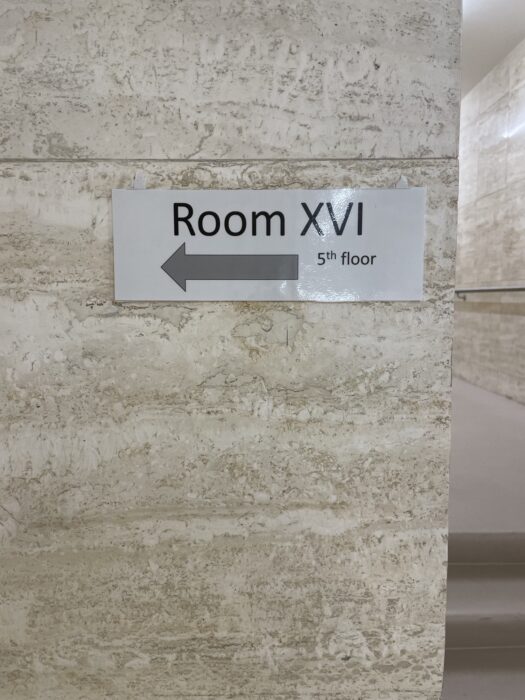
Due to building renovations, this session we were out of our familiar combination of scary/spectacular ceiling stalactites and underground bunkers and relocated in the historic grand old rooms of the original UN building. It was awful. No one knew where they were going for weeks and just as we got the hang of it, the secretariat threw in their own hazing ritual and moved us to room XVI (that’s 16 folks) for the all-important voting. For those not familiar, room 16 is on the 5th floor. Room 15 is nowhere near and room 17 is a short bus ride away. I suspect there are delegates still lost in the building vaults, clinging to their voting instructions and growing ever more desperate for the loo.
The session itself went pretty well. While the horrors in Gaza and Ukraine have dominated media headlines, the situation in Sudan over the last two years has had relatively little attention. It is a human rights catastrophe and the world’s worst humanitarian situation with 12 million people forced from their homes, and 9 million on the brink of starvation as a result of the conflict. Working alongside Ireland, Germany, The Netherlands and Norway, my colleague Gemma Edom led the resolution which renewed the Council’s Fact-Finding Mission for another year. It is the only UN body collecting objective information on violations and abuses by all warring parties and its renewal was essential. It was encouraging to see many African Council members engaging on the resolution and South Africa showed impressive leadership by voting in support of the resolution for the second time.
Among other highlights, the long running resolution on Sri Lanka passed without a vote and continued the important work that the UN’s human rights office is doing to advance accountability for serious conflict-era violations and abuses. Council attention has had a positive impact on Sri Lanka since it came onto the agenda in 2012 under a former Government– back then enforced disappearances and extrajudicial executions were still taking place. The current Government has made impressive public statements on the importance of reconciliation and made a range of commitments on moving forward from its legacy of ethnic conflict. Let’s hope these commitments will be put into practice soon.
The UK worked in close partnership with Somalia to transform a longstanding independent expert mandate into a programme focused on helping Somalia to build domestic institutions. Somalia’s engagement with the Council is commendable and when states seek this sort of assistance, it is crucial that the Council responds positively.
There was much attention on a new investigative mechanism on Afghanistan led by the European Union. The idea of a new mechanism has been under discussion for some years now and this session the EU decided that the Taliban’s growing atrocities, especially against women and girls, required the strongest type of body that the Council has to offer. In a welcome show of unity, the Council adopted the EU’s resolution without a vote – the first time a mechanism of this kind has never been voted. It clearly demonstrated the universal condemnation shared by the international community towards the Taliban’s behaviour.
In another Council first, my colleague Kameni Chaddha skilfully oversaw the first ever merger of two separate Council mandates, creating a new Special Rapporteur on Contemporary Forms of Slavery and Trafficking in Persons, led jointly by Argentina, Australia, Germany, Jordan, the Philippines and the UK. The new combined mandate should ensure a stronger response to this growing global concern and is an important first step by the Council to improve efficiency – something the UN Secretary General has called on the whole UN system to do.
I nearly didn’t write a blog for this session. As terrified as I am of AI, I thought I’d see what all the fuss is about and I tasked the artificial hive mind with drafting a blog in my style with jokes about shopping and facial hair. It turns out that a near infinite number of algorithms has a pretty good sense of humour. But for now this is still actually me. I’m going to wink just so you know for sure.😉 AI would never have thought of that.
And I managed another personal discovery this session. As age has taken hold, I’ve had an increasingly difficult relationship with my former friend SLEEP. I’ve tried pretty much every (legal) remedy and it turns out a night time kiwi was what I needed all along. I thank national treasure Jamie Oliver for pointing me in the right direction and if you’re afflicted by 3 am insomnia, why not give a kiwi a go?

I wish you all a pleasant autumn. I’m heading off for a little break, and hope many of you are too. Wherever you may be going, I hope you safely find your way.